
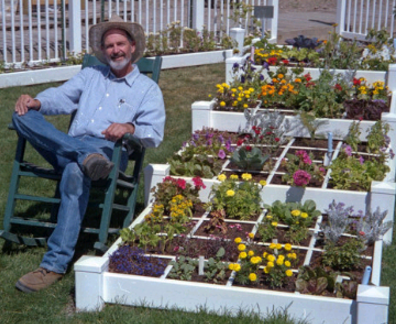
What is square foot gardening? A simple, unique and versatile system that adapts to all levels of experience, physical ability, and geographical location. Grow all you want and need in only 20% of the space of a conventional row garden. Save time, water, work and money! I am following the square foot gardening method, and I'll be using it as a reference through out the blog. Square foot gardening invented by the genius Mel Bartholomew! Learn more about it in his website , Or order his very very valuable book. It may come in downloadable PDF files too, if you search. 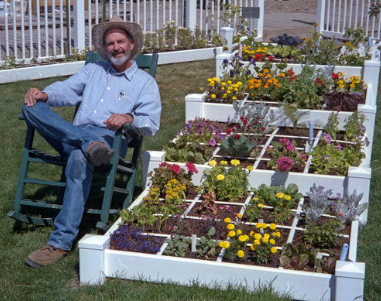
Here are the 10 things that make SFG different from traditional row gardening:
- Layout. Arrange your garden in squares, not rows. Lay it out in 4′x4′ planting areas. Companion plants can help each other grow bigger and tastier!
- Boxes. Build boxes to hold a new soil mix above ground. Your existing soil doesn't matter! forget about it, and just worry about the new soil called Mel's Mix.
- Aisles. Space boxes 3′ apart to form walking aisles. It makes it easier to walk and sit around the boxes, especially when your plants get really big and spill out of the boxes a little.
- Soil. Fill boxes with Mel’s special soil mix: 1/3 blended compost (please please make your own! The compost sold in Kuwait is a little shady) , 1/3 peat moss, and 1/3 coarse vermiculite (All available in True Value).
- Grid. Make a permanent square foot grid for the top of each box. A MUST!
- Care. NEVER WALK ON YOUR GROWING SOIL. This is how the soil stays so fluffy and airy for the roots stay happy. Tend your garden from the aisles.
- Select. Plant a different flower, vegetable, or herb crop in each square foot, using 1, 4, 9, or 16 plants per square foot. You might, for example, plant a single tomato in a square, but you’d plant 16 carrots in another. Using this system, you can cram a lot of garden into a small space and still get excellent yields.
- Plant. Conserve seeds. Plant only a pinch (2 or 3 seeds) per hole. Place transplants in a slight saucer-shaped depression. This means you wont waste seeds! The traditional way is to plant lots of seeds then cut off the majority and leave the strongest.
- Water. Water by hand from a bucket of sun-warmed water.
- Harvest. When you finish harvesting a square foot, add only compost and replant it with a new and different crop.
 I decided how big of an area I want to use, I am placing my SFG on the roof of my house, which I made sure received at least 8 hours of full sun. I am going big and starting with lots of boxes. So after thorough planning I decided I want two 4x4 square foot boxes (which is the standard) two smaller boxes for root vegetables like carrots and potatoes, and one long box for herbs. You can download the guide I created for the carpenters here . Its not the most accurate illustration of what the boxes look like in the end, but the numbers are right.
 You can change the measurements how ever you like, most importantly, you have to make sure each square is 1ft squared in size= 30 cm. Also Most vegetables require 6 inches of soil, I've decided to use around 20cm. If the boxes are placed over a garden/soil, they don't need bottoms. In my case, I have to apply bottoms since they're going to be in the roof. The bottoms are waterproof 2cm thick plywood. The plywood has to have around 0.6 cm holes drilled in each square, plus in the corners. My boxes have weird squares in the plywood because the carpenter mistook 0.6cm for huge 6cm holes, I had them fix them without problems. Potato/Carrot beds:
  One of the 4x4' beds with the herb bed:
 You can of course build your own boxes, and a very detailed guide is in the book. Im sure its much more fun.I don't have the skill or time, so I had the boxes done for 50KD total, 30 for the wood and 20 for the building. The work was done by Ibrahim in Classic Design Carpentry :
  Don't forget, you can collect sawdust for free and use it as a carbon source in your compost! Maybe I'll paint the outsides of the boxes with the kids before the season starts, what do you think?

25001 comments
Thanks for the marvelous posting! I actually enjoyed reading it, you happen to be a great author. I will make sure to bookmark your blog and will often come back later in life. I want to encourage you to ultimately continue your great writing, have a nice evening!
аренда мебели для проведения конференции Качественная мебель для проведения конференций. Полный сервис от профессионалов.
Hello folks!
I came across a 149 useful tool that I think you should explore.
This resource is packed with a lot of useful information that you might find helpful.
It has everything you could possibly need, so be sure to give it a visit!
[url=https://www.treking.cz/servis/352_narodni-parky.htm]https://www.treking.cz/servis/352_narodni-parky.htm[/url]
And do not neglect, folks, which you always may in the publication locate solutions to the the very confusing questions. Our team attempted — explain the complete information via an most accessible method.
The best base layers we tested
Best wool base layer: Minus33 Ossipee Women’s Midweight Crew
[url=https://vk.com/video867628273_456239017]гей онлайн[/url]
Best synthetic base layer: Patagonia Long-Sleeved Capilene Thermal Crew
[url=https://dzen.ru/a/YlMw1Uli1FtV6HId]гей порно геей[/url]
It’s officially cozy season, so it’s the perfect time to shop for a new pair of the best base layers to wear under your ski clothes or winter hiking outfits. However, with so many options and a wide range of price points, it can feel overwhelming to sort through them all on your own. Plus, there’s that looming, age-old question: wool or synthetic?
[url=https://scamsstop.com/unite-to-live.html]русское гей порно[/url]
For one thing, wool apparel has come a long way since the days of scratchy sweaters gifted by grandma. Today, merino wool accounts for a significant portion of the base layer market, featuring ultra-fine fibers that effectively wick sweat away from the body and are naturally odor-resistant. Conversely, synthetic fabrics are generally more durable and don’t raise the same animal welfare concerns as wool products. Pro tip: Always look for non-mulesed wool or a note from the brand stating that the wool was gathered safely and sustainably.
I have to admit that when I first started playing hard in the snow, I was a merino-only person who loved its lightweight warmth on shoulder-season backpacking trips and frigid ski slopes. But there’s a wealth of uber-toasty synthetic long johns that dry quicker and often last longer because of their enhanced durability. I spent the last two months testing the top wool and synthetic base layers on backpacking trips in the Rockies, day hikes in Glacier National Park and chilly dog walks outdoors around Boulder, Colorado. Below are the best wool and synthetic base layers to keep you warm all season.
смотреть жесткое порно
https://vk.com/topic-195729314_54091658
Приветствую Вас, сетевой народ!
Посетите любопытный вебресурс [url=https://janusms.ru/2025/11/14/telefonnyj-razgovor-kir-bulychev/]путешествие во времени у Булычева: Телефонный разговор[/url]
Храни всех Бог.
Ефим