
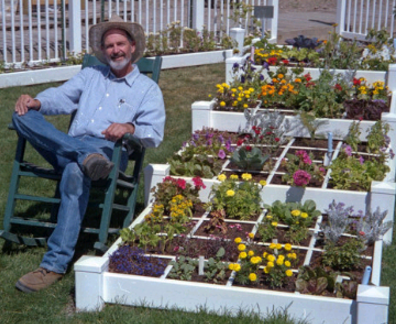
What is square foot gardening? A simple, unique and versatile system that adapts to all levels of experience, physical ability, and geographical location. Grow all you want and need in only 20% of the space of a conventional row garden. Save time, water, work and money! I am following the square foot gardening method, and I'll be using it as a reference through out the blog. Square foot gardening invented by the genius Mel Bartholomew! Learn more about it in his website , Or order his very very valuable book. It may come in downloadable PDF files too, if you search. 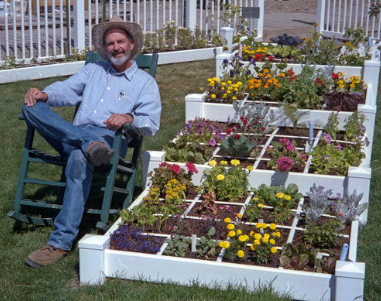
Here are the 10 things that make SFG different from traditional row gardening:
- Layout. Arrange your garden in squares, not rows. Lay it out in 4′x4′ planting areas. Companion plants can help each other grow bigger and tastier!
- Boxes. Build boxes to hold a new soil mix above ground. Your existing soil doesn't matter! forget about it, and just worry about the new soil called Mel's Mix.
- Aisles. Space boxes 3′ apart to form walking aisles. It makes it easier to walk and sit around the boxes, especially when your plants get really big and spill out of the boxes a little.
- Soil. Fill boxes with Mel’s special soil mix: 1/3 blended compost (please please make your own! The compost sold in Kuwait is a little shady) , 1/3 peat moss, and 1/3 coarse vermiculite (All available in True Value).
- Grid. Make a permanent square foot grid for the top of each box. A MUST!
- Care. NEVER WALK ON YOUR GROWING SOIL. This is how the soil stays so fluffy and airy for the roots stay happy. Tend your garden from the aisles.
- Select. Plant a different flower, vegetable, or herb crop in each square foot, using 1, 4, 9, or 16 plants per square foot. You might, for example, plant a single tomato in a square, but you’d plant 16 carrots in another. Using this system, you can cram a lot of garden into a small space and still get excellent yields.
- Plant. Conserve seeds. Plant only a pinch (2 or 3 seeds) per hole. Place transplants in a slight saucer-shaped depression. This means you wont waste seeds! The traditional way is to plant lots of seeds then cut off the majority and leave the strongest.
- Water. Water by hand from a bucket of sun-warmed water.
- Harvest. When you finish harvesting a square foot, add only compost and replant it with a new and different crop.
 I decided how big of an area I want to use, I am placing my SFG on the roof of my house, which I made sure received at least 8 hours of full sun. I am going big and starting with lots of boxes. So after thorough planning I decided I want two 4x4 square foot boxes (which is the standard) two smaller boxes for root vegetables like carrots and potatoes, and one long box for herbs. You can download the guide I created for the carpenters here . Its not the most accurate illustration of what the boxes look like in the end, but the numbers are right.
 You can change the measurements how ever you like, most importantly, you have to make sure each square is 1ft squared in size= 30 cm. Also Most vegetables require 6 inches of soil, I've decided to use around 20cm. If the boxes are placed over a garden/soil, they don't need bottoms. In my case, I have to apply bottoms since they're going to be in the roof. The bottoms are waterproof 2cm thick plywood. The plywood has to have around 0.6 cm holes drilled in each square, plus in the corners. My boxes have weird squares in the plywood because the carpenter mistook 0.6cm for huge 6cm holes, I had them fix them without problems. Potato/Carrot beds:
  One of the 4x4' beds with the herb bed:
 You can of course build your own boxes, and a very detailed guide is in the book. Im sure its much more fun.I don't have the skill or time, so I had the boxes done for 50KD total, 30 for the wood and 20 for the building. The work was done by Ibrahim in Classic Design Carpentry :
  Don't forget, you can collect sawdust for free and use it as a carbon source in your compost! Maybe I'll paint the outsides of the boxes with the kids before the season starts, what do you think?

25001 comments
Идеальным подарком станет [url=https://www.braceletdiamond.ru/]браслет с бриллиантом купить[/url], который подчеркнёт вашу уникальность и безупречный вкус.
Даже после длительного использования камни сохраняют свой искрящийся блеск.
I absolutely love your website.. Very nice colors & theme. Did you make this website yourself? Please reply back as I’m hoping to create my own personal site and would love to learn where you got this from or exactly what the theme is called. Many thanks!
посмотреть в этом разделе http://maps.google.com.bn/url?q=https://letundra.com/es/news/?taglist=emirates
Uncensored japan the best free uncensored japanese porn
free buff gay guy porn nickolodeon porn fakes porn tube erin andrews annimation hardcor porn porn tebehttps://violavii-anabel.titsamateur.com/?kendal-katelin
Tripscan — это современная платформа, которая помогает компаниям эффективно управлять своими маршрутами и логистикой. Наш сервис предоставляет удобный интерфейс для планирования и отслеживания поездок, что значительно сокращает время и повышает точность выполнения задач.
[url=https://tripscan66c.cc]трипскан сайт [/url]
Трип скан — это надежное решение, которое интегрируется с различными системами учета и автоматизации. Благодаря Trip scan вы сможете быстро анализировать маршруты, оптимизировать расходы и контролировать выполнение заказов в реальном времени.
[url=https://tripscan66c.cc]трипскан вход [/url]
Tripscan top — это наша эксклюзивная функция, которая позволяет пользователям получать наиболее актуальные данные о движении транспорта и эффективности маршрутов. Используйте трипскан вход для авторизации и доступа к расширенным возможностям платформы.
[url=https://tripscan66c.cc]tripscan top [/url]
Для новых пользователей у нас есть удобный трипскан сайт, где можно ознакомиться с функционалом, зарегистрироваться и начать использовать сервис уже сегодня. Трипскан сайт обеспечивает простоту и безопасность работы с данными, а также поддержку на всех этапах.
[url=https://tripscan66c.cc]tripscan [/url]
Выбирайте Tripscan — ваш надежный партнер в сфере логистики и транспорта. Откройте новые горизонты с Tripscan top и убедитесь в эффективности нашего сервиса!
https://tripscan66c.cc
tripskan